

Warehouse wave planning agent
Problem
Building a wave plan means manually pulling every open order, checking it against picker capacity and dock door availability, sorting by carrier cutoff and priority, and catching problems like overloaded zones or missed carrier windows before they cause delays on the floor. Done by hand, that process is slow and error-prone, and issues like dock door backups or capacity shortfalls often aren't caught until picking is already underway.
Solution
An AI agent that plans a full day's wave assignments end to end: gathering warehouse inputs, validating open orders, checking capacity against defined thresholds, and building a draft wave plan sorted by carrier cutoff, priority, zone, and weight. The agent presents the full plan to a supervisor for review, revising it as many times as needed, and writes nothing until it's approved. Once approved, the agent creates the wave records and continues watching for exceptions, such as dock door backups, carrier cutoff risk, or labor shortfalls, throughout the day.
At a glance
Vertical
Distribution
Logistics
Manufacturing
Retail & Sales
Used By
Operations
Supply Chain
Building Blocks

Agents
Decisions

Human-in-the-Loop

Custom Applications
Logic Blocks

Building Blocks
This solution was built using these Nextworld features
Agents
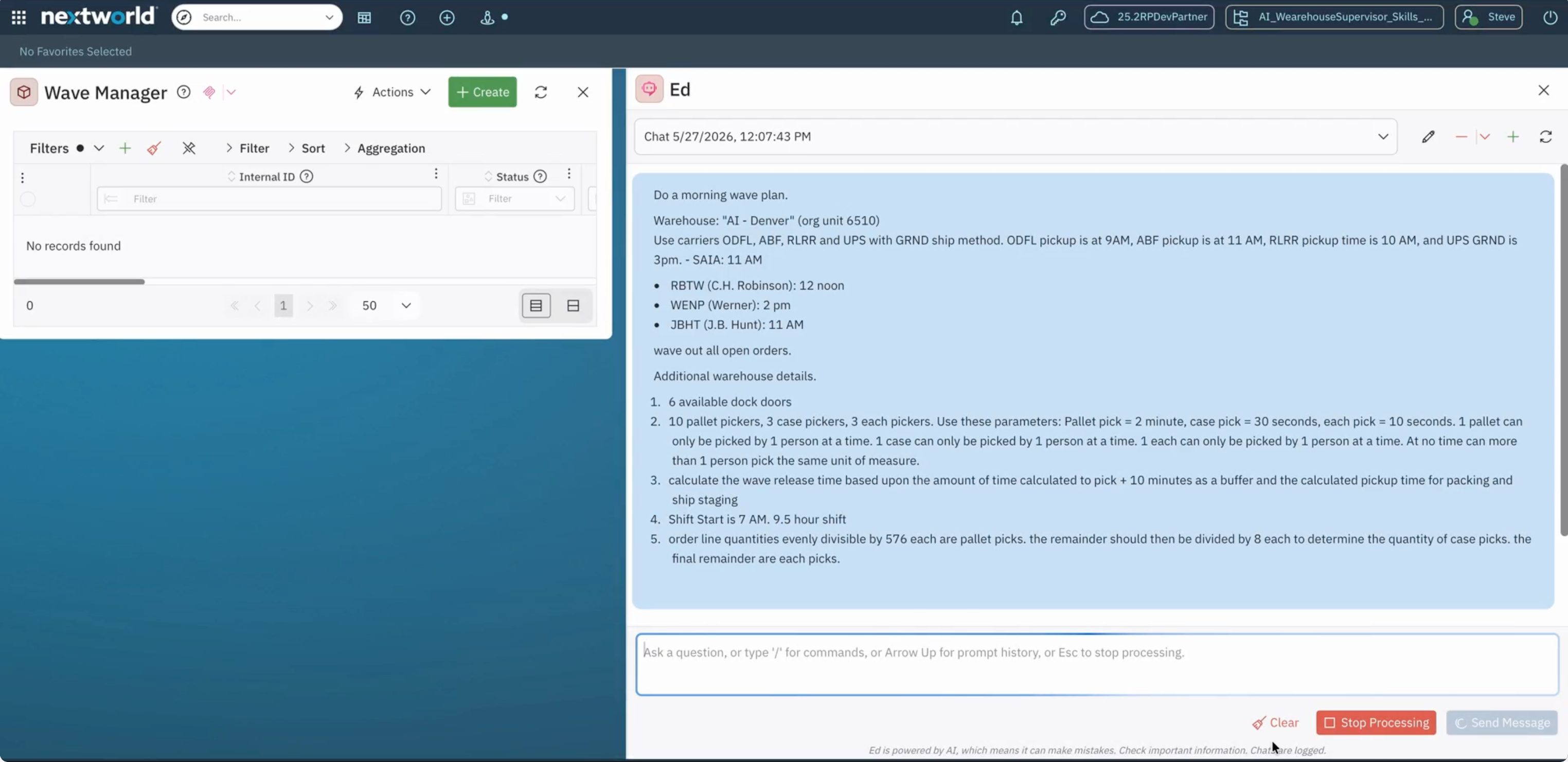
Runs the full planning cycle: gathers inputs like warehouse, dock doors, shift times, picker-by-zone availability, and carrier pickup times, then reads and validates open orders before building a draft wave plan.
Decisions
Capacity is checked against defined thresholds based on pickers, rate, and hours available, classifying each wave as OK, at risk, or short before the agent proceeds to build the plan.
Human-in-the-Loop
The agent presents the full draft plan to a supervisor, who can request changes and get a re-rendered plan as many times as needed. Nothing is written to the system until the supervisor approves.
Custom Applications
Once approved, the agent creates wave headers in the Wave Manager App, writes wave details in batches, reverse-links order lines back to their source orders, and verifies totals match before finishing. The Outbound Orders App is the source of open order data the agent reads from during planning, including order lines, unit-of-measure breakdowns, and carrier assignments.
Logic Blocks
Runs continuous exception monitoring throughout the day, watching for conditions like dock door backups, carrier cutoff risk, priority conflicts, allocation failures, zone imbalances, overloaded waves, newly arrived urgent orders, and labor shortfalls, and surfacing them as they occur rather than waiting for the next planning cycle.







Powering the teams behind modern operations
What will you build with Nextworld?
Bring us the process that costs you the most, and we’ll show you how it runs on an ERP you grow into, not out of.
