
Automated customer support ticket resolution
Problem
This support team's 85,000+ resolved tickets held the answer to most new issues that came in, but that knowledge was fragmented across Freshdesk and legacy NetSuite and Salesforce data, with no practical way for customer support agents to search across all of it. They spent significant time researching issues a colleague had likely already solved. The team needed to put that prior work in front of support agents the moment a new ticket arrived, so they could reach the root cause faster and deliver more complete resolutions.
Solution
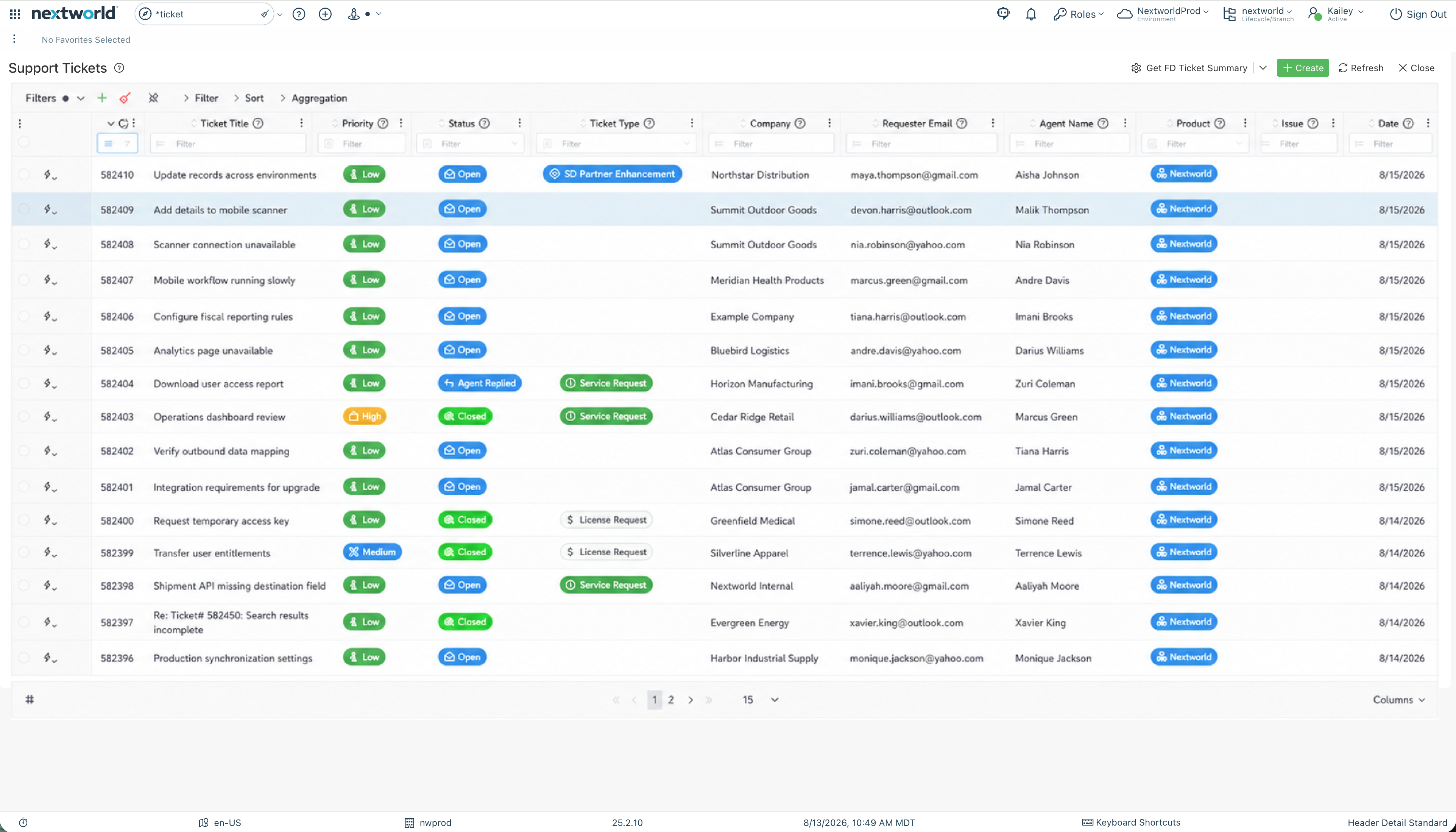
A custom application that ingests every new Freshdesk ticket, runs a semantic search across 85,000+ historical tickets, and uses an AI model to generate a recommended next action delivered to the customer support agent as a private note in Freshdesk—including citations to the historical tickets it drew from. Early estimates show a 10% efficiency improvement, equivalent to roughly 1,000 working hours saved each year.
At a glance
Vertical
Telecommunications
Hospitality
Manufacturing
Retail & Sales
Used By
Customer Support
Operations
IT
Building Blocks

Custom Applications

Webhooks
Logic Blocks

Large Language Models

Semantic Search
Endpoint Definitions
Building Blocks
This solution was built using these Nextworld features
Custom Applications
The Support Tickets application is structured as a header application with two related detail applications, one for the conversation messages on the incoming ticket and one for the similar historical tickets returned by semantic search. That structure is necessary because each ticket has many messages and many similar-ticket matches.
Webhooks
Webhooks automatically send ticket data from Freshdesk to Nextworld whenever a ticket is created, updated, or closed.
Logic Blocks
The application uses several logic blocks across the process. The primary one writes incoming ticket data to the header application, runs the semantic search against historical tickets, scores similarity, and validates the AI's recommended next action before sending it back to Freshdesk. Supporting logic blocks generate AI summaries of closed tickets so they can be searched against future tickets, and filter out spam or out-of-office replies before they trigger the main process.
Large Language Models
Large language models handle the language work: summarizing closed tickets so they can be searched, and generating the recommended next action delivered back to the support agent.
Semantic Search
Semantic search finds the closed historical tickets most relevant to the current one. Unlike keyword search, it matches on meaning rather than exact wording. The search runs against ticket summaries stored as vector embeddings in the Nextworld database, scanning more than 85,000 tickets and returning the top 100 candidates scored as same, similar, or not similar.
Endpoint Definitions
Freshdesk endpoint definitions call the Freshdesk REST API to retrieve ticket details and post recommended next actions back to the ticket. The system also includes related historical ticket numbers to help customer support agents make informed decisions. This information is visible only to support agents.







Powering the teams behind modern operations
What will you build with Nextworld?
Bring us the process that costs you the most, and we’ll show you how it runs on an ERP you grow into, not out of.
